A Quick Run-Through of More Sites: The Defensive and Natural Landscape of Ireland

0 comments

Late last week, I moved into a new apartment closer to the city centre, which has had Internet problems, making getting onto the blog a little more difficult to anticipate.  However, now that things seem to have cleared up, I think I'll be able to post a bit more about my adventures in Ireland (although still no solution for the bad dryer-- my room in cover in damp clothes hanging off every available surface to air dry).

Last week, along with my usual class lectures, we had some more field trips to the Garranes Ringfort, the seat of a local king in the Early Medieval period, which was made completely of wood which has now rotted and earthworks which still stand (although the mounds are no longer as high and ditches no longer as deep).  Being the seat of a local king isn't as impressive as it may sound though, there were well over one hundred of the buggers in Ireland at the time.  Due to the lack of urbanization at the time, it also lacks the same clout as the impressive fortified cities found on the continent during the same time, but still a fun place to walk around and imagine at.

Part of the Ringfort's earthworks.  You'll have to imagine a deeper trench, taller mounds, and a palisade along top.
The same trip also visited Ballincarriga Tower House, which is a standard tower/castle/residence of the Late Medieval, and so I'll gloss over it quickly by describing it as a standard tower/castle/residence of the Late Medieval (which is to say, a big tall square tower).
Look how big and square
Sarcasm aside, it was an impressive site, but somewhat lessened with the knowledge that there were a few thousand of the things around back in the day (even some farmers and townspeople could afford the thing!  Don't worry though, this is a proper nobleman's castle).

The interesting bit of the trip was Coppering's Court, which is another big stone house, castle-like but primarily just a wealthy nobleman's house rather than a true defensive feature.  It was crumbling to the point where there's an ever present risk of large chunks of masonry falling down so we couldn't get inside the thing, and to get close to the thing we needed to go through a fence, than through and electric fence, then hop up over a stone fence (the stone fence was authentic though, going back to the days when Coppering Court was in use-- the rest was modern).

Good heavens, this blog is getting long.  Guess I'll have to speed by a few stops.

Drombeg was a nifty stone circle, but those things are of unclear purpose and so I couldn't have much to say even if I wasn't pretending that having a long entry was bad.  Also, it had places called "fulchta fiadh" which were probably used for boiling meat by dumping red-hot rocks into the pools, although again we can't be certain.  They date waaayyy back to the stone age, but Early Medieval sagas mention them still being used (and they were certainly being used for cooking then, but the Early Medieval Irish also used Stone Age ritual sites for prisons and the like so that may not be the original purpose).  


And there was a whole nother field trip that I'll just hit the highlight of: Mitchelstown Caves.  They aren't really of any historical value, but it was rather pretty.  The caves run many kilometers in just about all directions, though only part of it is available to the tourists.


  I was able to geek out over it quite a lot, because the combination of stone caverns with carved-out stairs made it closer to a fantasy world dungeon than the touristy caves I've visited in the States.
Ah!  A hideous cave troll!

Elusive Castle

0 comments

Two weeks of my July were spent in Lisbon, Portugal. I'd never been on a plane before, let alone abroad, so I wanted to make the most of the trip. And by that I mean I wanted to see a castle. That was my main goal. I didn't care what kind of castle, or how big it was. I just really needed to see one, for whatever reason.

I never thought trying to see a castle would be so difficult. When my Lisbon companions and I first attempted to visit Sintra, a castle and garden an hour or so away from our hostel, we severely underestimated the exhaustion level we'd face in those first few days. We signed up for the tour, had our breakfast, went back to the room to regroup, and promptly fell asleep for three hours.

"It's okay," we thought. "It's early in the trip. We can go whenever." But we were wrong. Over the next few days, we each became engrossed in different things. The purpose of the trip was to attend a writing workshop, so most worked on their readings or writings in the time we had off. The end of our trip neared and we still had not seen the castle. I began to panic. No one else seemed to remember that the castle was the objective. The Holy Grail of touring Portugal. I pestered them until, finally, we decided on a day to visit.

The day arrives, and we are all ready to go. The castle is happening. We're going. But then, tragedy struck. The bus that would take us to Sintra had broken down, and would not be running until at least the next day. My suffering continued.

In a fantastic turn of events, on the last full day of our trip, two of my group members and I rallied together and went on the tour. I'd never been more excited to walk around in 90 degree heat. The castle was not only beautiful, but it was so culturally rich. I felt like I was walking into a film set. Plus, there was a castle cat and he let me take tons of pictures of him, so really the trip was the best day of my life.

Flying In and Forts in Caherdaniel

0 comments

Last week I flew into Cork, where I'll be spending the semester studying at UCC.  Classes start up tomorrow, so naturally I decided to spend the past week wandering around the city to get familiar and go visit some ancient ruins 140 kilometers away in Co. Kerry, near the small town of Caherdaniel.

Staigue Stone fort is a decent-sized round stone fort of a local lord, around 30 meters across, built in early first century.  It was an impressive sight, and certainly worth the meager one-euro entrance fee, although there wasn't much information about the fort on location (only a small sign with one paragraph in Irish and one in English).


The second stone fort, Caherdaniel Stone Fort, is smaller and I had wished the tourism websites would let me know it's in the middle of a farm that you aren't allowed on, so you can't actually get to the fort itself.  Hopefully this isn't the start of a trend.

Welcome Back

0 comments

Welcome Back!

Ancient, Medieval and Renaissance Study folks are a peripatetic bunch!  And the faculty often spend much of their summer traveling abroad to conferences to deliver papers, visiting museums, and exploring archives, archeological sites, and historic monuments.

This year, to re-launch our AMRS Blog Abroad, I'd like to invite all AMRS faculty and students to post an image or two about their summer travels.  Tell us where you went, and what you saw.  We'd love to learn.

Below is an image of Patience Agbabi, one of the latest and most talented artists to be inspired by Chaucer.  If you follow this link, you'll hear her brilliant cover of Chaucer's Tale of Melibee, the one Canterbury Tale told by Chaucer himself.

Agbabi  gave a dramatic reading at this year's New Chaucer Society conference, held this July in London. I couldn't tape myself from that performance, but here she is on Youtube.

Enjoy!
Patricia DeMarco
Director, AMRS


Patience Agbabi performs a Canterbury Tale.

Cambridge

3 comments


On the way to Cambridge, we stopped at an American war cemetary, which was intersting... yet I felt only done because we are Americans, and thus it was a little silly. Our British tour guide got the staff to give us free booklets about the site because we are American.


Cambridge, which the folks here call 'the other place,' was a very lovely city. I think I may have even liked it better than Oxford, though it is hard to say after only a day's visit. I think it may have only seemed more beautiful because of its seclusion and the fact that all the beautiful buildings were not clustered on top of one another. In Oxford, a building may be extraodinary, but you can't fully appreciate it because it's right next to five other amazing buildings; the sense of beauty is dulled, whereas the nature of Cambridge enhances it.


I wasn't aware that Cambridge placed such an emphasis on the sciences and technology. We visited the 'modern' part of campus, which was very modern indeed and featured a European headquarters for Microsoft and a huge academic building patronized by Bill Gates.


We visited King's College, which was exceedingly beautiful, particularly its cathedral. This had been filled with propogandic bas-reliefs by Henry VIII and then used as a stable for Oliver Cromwell's army during their campaigns to destroy priceless stained-glass and other royal iconography during the Civil War. Luckily, the usefulness of the building's windows to keeping the army and animals warm prevented their destruction. Oh and it also has the largest fan vaulting, I think in the world.


I ate lunch at a pub called The Eagle, where Watson and Crick discussed their research. While they 'discovered' DNA, I discovered that Steak and Ale Pie is the most delicious thing ever.


In other news, Hugh Laurie attended Cambridge, where he pursued rowing, following in the footsteps of his Olympic-winning father, that is until he lost to Oxford, and decided to turn to acting.


Cambridge also presented by far one of the coolest things I have ever seen--a clock built by alumnus John Taylor. It possesses a large gear that ticks in rotation with each second, whilst a large and sinister insect hybrid sits atop and eats the passing moments. For you Greek-learned, the architect fittingly named it the 'Chronophage.' It is supposed to remind us of Time's consuming nature, and that it is not on our side. There is also more to it about the time only being completely accurate every once in awhile, but I did not really understand that bit. While slightly creepy, it was completely awesome. Sadly my picture did not come out well, but it's really something you need to see in person for the full impact anyway.


To escape the cool, English drizzle we retreated to Cambridge's free museum (I'm loving this country's embrace of free museums), which like most others here, consisted mostly of Greek, Roman and Egyptian artifacts. Apparently somewhere in one of the libraries was the first manuscript of Winnie the Pooh, though I did not get to see it.


Portsmouth

1 comments


The next trip sponsored by the program (so I suppose ultimately sponsored by us...) was to Portsmouth, a port city (who knew!) on the Southern coast of England. We spent the day exploring the harbor, and England's naval history. We were given all inclusive passes to visit three historic battleships and various museums and tours. Unfortunately, one of the three ships was undergoing preservation processes and another had a set tour time, which I and many others missed to due some misguidance and a fast clock. Alas. But I did get to wander freely about the battleship Warrior, which as fascinating.


The museums contained lots of interactive activities for children, all of which I annihilated, and a whole lot of prow sculptures, many of which were mythological figures. I must say, I do not like what they did with Calliope. I thought she was supposed to be Jane Austen.


The day was sunny, for once, and we managed to find a very strange and somewhat random stone path that just disappeared into the water, from which we watched the sunset. It was beautiful.

Stonehenge and Bath

1 comments


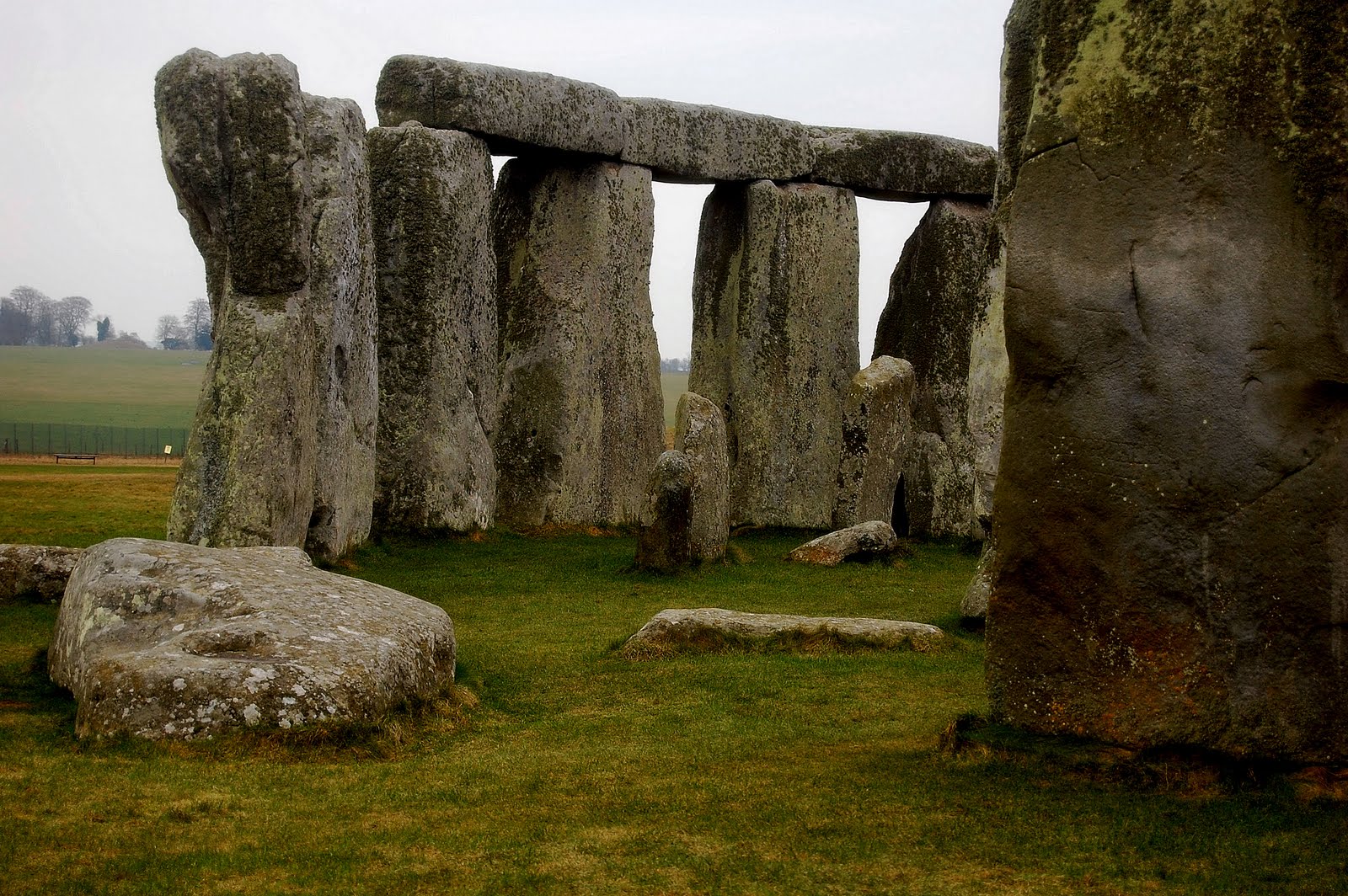
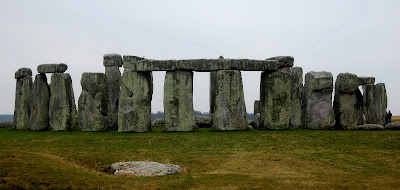
The OSAP program went on its 2nd of 4 trips this past weekend [*now many weekends ago*], this one to Stonehenge and the city of Bath. I thought the trip was very nice, but a lot of people thought the sheep garzing in a nearby field were the highlight of the day.

I suppose old rocks don't do it for everyone.


Stonehenge was very VERY cold. So cold that I got halfway through the first audioguide speech before calling it quits and returning my hands to their pockets. I honestly don't understand why so many students were disappointed, since that implies they had some sort of expectations that were not fulfilled. It was exactly what I expected. They're rocks; they're not going to put on a show for us. I think the true grandeur of the site is crippled by the fact that it is such a prominent tourist site. Just imagine if you came upon those rocks at random while taking a stroll through a field... pretty awe-inspiring. I mean, I was impressed enough by pillars of rocks someone had taken the trouble to stack in a creek at Old Elicott City, MD (=a lovely place. I highly recommend it if you're ever in the area). Anywho, we were only at the Henge for a little while, enough time to make a slow lap around the circle and peruse the gift shop.


Then we made the arduous treck (and by 'arduous treck' I mean a snoozey ride in a double-decker bus) to see the Roman Baths at Bath. Needless to say, they were pretty cool. I somewhat felt that the site was not particularly explanatory, for example about which baths served which function, but admittedly I did once again ignored the audioguide, which may have been more enlightening. There were several half-excavated areas on display, which made me nostalgic for my Rome days. The pictures I took would've been very helpful a few months ago when I wrote about these baths for Carol NdeV, but such is life. Like a good tourist, I bought a bottle of the bath water, which I shall of course keep for posterity.


The actual city of Bath was quite impressive. Some of the people on the trip even went so far as to say that it looked nicer than Oxford... I don't know if I'd quite agree with that, but its bigger city feel was a nice change. As night set on at its early winter hour, we walked the streets and came upon Bath's famous Roman bridge and some adorable tea and leather shops before the sleepy bus ride home.